Introduction
The two months since the swearing in of President Trump feel like we’re witnessing a fever dream play out in real time. In the last couple of months, we have seen Trump and Vance spar on live television with Ukrainian President Zelensky, mock Governor Trudeau of Canada by suggesting that Canada become a 51st state, float a deal to buy Greenland, and even rename the Gulf of Mexico to the “Gulf of USA.” There have also been a slew of unconventional financial measures, such as reintroducing tariffs on a much larger scale, introducing a new gold card visa for 5 million dollars, creating a cryptocurrency reserve, and establishing a sovereign wealth fund. There is a general sense that the old world order is running on fumes — but where are we headed?
There have been many long-form articles with similar titles to this one, as is the case after the first 50 or 100 days of any President’s tenure. While the general consensus seems to be that he is out to torch the 80-year-old post-WWII established order, most experts stop short of saying there is any method to this madness. To give one example, the New York Times article follows this trope by quoting John Bolton, National Security Advisor in President Trump’s first term, who writes:
Mr. Bolton contends that Mr. Trump “does not have a philosophy or a national security grand strategy.” “He does not do ‘policy,’ but a series of personal relationships.” Now his aides are scrambling, with little success, to impose a logic to it all.
I began this blog-series about 2 months ago with (and because of) a postmortem of Donald Trump’s win in the 2024 elections in the USA and the events that led to his victory. The following posts briefly touched on the anti-incumbency sentiments in the USA and across the world, which fueled his victory. However, I had been thinking about writing on the implications of these undercurrents and why the current moment is historical, but I hadn’t quite found the right hook or timing for it.
Waiting for my hook, I found it at recent India Today's Conclave, where former US Secretary Pompeo had an hour-long, testy exchange with some of India’s premier journalists. A similar fractious theme was followed in another half-hour interview with the newly appointed Secretary of Commerce, Howard Lutnick.
I recommend that readers make their own conclusions from the interviews—they’re well worth a watch, particularly for an Indian audience. A couple of the big takeaways from my end, particularly on Pompeo’s interview:
It was jarring to see the extent of crosstalk between the journalists and Pompeo. Clearly, both parties were not on the same page on various narrative arcs, but the journalists were particularly abrasive towards Pompeo, taking him to task for President Trump’s actions since his inauguration. Pompeo, being the visitor, held back for the most part; however, at one point, he shot back at one of the journalists, saying it was indecent of her to suggest that Trump had no empathy for the people in Gaza.
The interview once again reaffirmed that the ongoing “Battle of Elites” is truly global in nature, with similar themes echoing in all parts of the world. It would not be surprising if someone suggested that it was CNN or NYT on the journalists’ side instead of Rajdeep or Amit Shah instead of Pompeo.
More importantly, there seems to be a wide chasm on how seriously Trump should be taken. This is a familiar trope in both American and international media, with some suggesting that Trump should be taken seriously but not literally, etc., etc. This is rather surprising, given that Trump is once again the leader of the free world - but perhaps it reflects how the elite personally view him or a response to America’s diminishing stature as a hegemon. I tend to think it is the former, but either way, it would be a grave mistake to not take a second term president who understands the system and is out to upend it seriously.
While American tariffs and the response to it are an immediate concern, there are a whole host of issues governments around the world have to contend with as I point out in this post.
In my upcoming posts, I would like to take a step back and present a big picture view on the state of the world as the Trump world sees it, as I see it, and the implications going forward. Given the complex nature of the topic and the scale of the reforms Trump’s team is planning, I will limit myself in this post to expanding upon the Trump 2.0 doctrine and what it means for the world. Love him or hate him, he’s a symptom of something much bigger - the end of a world where American power and global institutions functioned as they did in the post-WWII era. There might not even be a "method to the madness" necessarily but the confluence of events are pointing in a certain deliberate direction. If you step back, there’s a clear through line: the cracks in the existing system are widening, and something new is taking its place. The question isn’t whether change is coming - it’s what shape it will take.
Trump 2.0's Intellectual Capital
A useful starting point to understand the scale of Trump’s moves in his second term is President Trump’s designated chair of the Council of Economic Advisors (CEA), Stephen Miran’s November 2024 paper, appropriately titled “A User’s Guide to Restructuring the Global Trading System.” Miran’s paper, which coined the term “Mara-Lago Accord” and has since been used by many, tries to lay out the intellectual justification for Trump’s aggressive interest in trade barriers by describing the current state of the world as a “Triffin World,” taking its cue from Belgian economist Robert Triffin. This is the first of the various potential “worlds” Miran presents in his paper—from the differential simulations of the impact of wide-ranging reciprocal tariffs, which he seems to be on board with, to changes in dollar policy, which he describes as less desirable.
While Miran is completely taken into the Triffin world, it is important to note that Triffin’s thesis has been revisited multiple times in trade and international macroeconomics and perhaps, ex-post, describes the fall of the Sterling as the global reserve currency between WWI and WWII. Per Bordo and McCauley (2018), while Triffin is remembered for having rightly called the break of the gold-dollar link in 1971 (in 1959–60), what Triffin got wrong is not much remembered. By definition, his thesis cannot be considered true unless the empire falls, and as he himself admitted in 1978, it has lasted longer contrary to the fears and expectations of most (including US policymakers).
"Let me also admit, however that I did change my mind about the main danger confronting the future of the international monetary system. While my initial diagnosis was seen by central bankers as placing excessive stress on the first horn of the Triffin Dilemma, the danger of world deflation, my later writings placed increasing stress on the second, the inflationary potential of continuing U.S. deficits…Even so, I was totally wrong in underestimating the duration and the size of the U.S. deficits that foreign central bankers would be willing to absorb, at the cost of an inflationary explosion of world monetary reserves and of a multiple expansion of the money supply in their countries under the traditional system of fractional reserve requirements." -- Triffin (1978)
Miran’s full paper will be read and re-read multiple times by many, but I would like to address two salient points which are at the heart of the paper here:
- Are tariffs inflationary?
In order to lay the groundwork for Trump’s tariffs, Miran has to get past the first hurdle of whether they are inflationary or not (for the American consumer). Here, Miran draws from the experience of the US–China trade war of 2018–2019 and the impact of tariffs placed on Chinese imports on the American consumer (and the intermediate producers). Miran’s basic thesis is that tariffs, in principle, can be noninflationary (wrongly, I might say), as he argues they are offset by changes in currencies. Taking the 2018–2019 period as a reference, his thesis would say that while the after-tariff price paid by American importers is higher, this is in reality offset by a devaluation of the Chinese Yuan to the US Dollar (either perfectly or imperfectly). Per Miran’s calculations, the effective tariff rate on Chinese imports increased by 17.9 percentage points, and the Chinese renminbi depreciated against the dollar over this period by 13.7%, so that the after-tariff USD import price rose by 4.1%. Miran points to the fact that US (core) CPI and PCE were broadly in the Fed’s target range of 2 percent.
However, contrary to Miran’s back-of-the-envelope macro calculations, more detailed item-level microdata studies (by Cavallo, Gopinath, Neiman, and Jang (2021), Fajgelbaum et al (2020), and Amiti, Redding, and Weinstein (2019)) conclude that tariffs are indeed inflationary for the American consumer. Miran ponders on this discrepancy, asking, “What can bridge the gap between the macrodata arithmetic and the results of microdata studies?” He offers three reasons: 1) short-run versus long-run effects; 2) price hikes occurred for prices paid by importers, not prices sold by retailers; and 3) re-export diversion from China to third countries, engaging in some minor processing, and then re-exporting to the United States.
While all three reasons are plausible - especially the third - a simpler explanation for the limited rise in inflation is the slowdown in global trade volume growth that started in the second half of 2018 and continued in 2019, reflecting weak global demand. It should be noted that this slowdown was pre-COVID-19; of course, trade volumes came to a complete halt once the pandemic hit. The official reports from that time document this—as outlined in the UNCTAD report from 2019 titled “International Trade Slump.” The report noted that the reasons were trade tensions between the United States and China, fears of a disorderly Brexit in Europe, and a generally negative global output outlook. Preliminary data for 2019 indicated a sharp decline in trade growth to negative 3 percent. Reduced demand can suppress price increases, thereby mitigating the inflationary impact of tariffs. It is difficult to know the long-run impact of tariffs solely based on the 2018–2019 experience, given the exogenous shock of the COVID-19 pandemic; however, this environment can lead to discrepancies between macroeconomic indicators, which may show subdued inflation, and micro-level observations that focus on specific goods or sectors where price adjustments occur more rapidly.
As I write this, I’m listening to Fed Chair Powell delivering somewhat of a master class on turning bad news into good, giving exactly what the markets expected and wanted — that is, to look through the “tariff inflation” as opposed to the “non-tariff inflation” (in Powell’s words). Powell acknowledged that “goods inflation moved up pretty significantly in the first two months of the year… clearly some of it, a good part of it, is coming from tariffs” and, at the same time, dismissed the uptick in long-term inflation expectations in the University of Michigan survey as an outlier. Implicit in Powell’s assessment is the historical Fed reaction function, which distinguishes between demand and supply side drivers of inflation. FOMC officials claim that, since they cannot do anything about the supply side drivers, they focus on demand side drivers such as wage inflation. However, the Fed would intervene if those supply side shocks spill over into other sectors, such as services. The Fed made a similar mistake in 2022 by failing to recognize the surge in post-pandemic inflation — calling it a “transitory” phenomenon due to supply shocks. They later had to admit that they were wrong and reverse their course, but the damage was done in the form of a broad-based upsurge in prices and inflation. A second round of the same phenomenon would be equivalent to pouring gasoline onto a corn field that is already on fire. What is the likelihood of that happening? Without going into too many details, wearing my technical analyst hat, I see the long-term chart patterns across almost all commodities screaming a bull run—I fail to see how this does not result in runaway inflation.
More importantly, there needs to be a fundamental rethink of the Fed’s framework, which remains deeply rooted in insular academic thinking that is not suitable for the current world. Robert Lighthizer, another heavyweight policymaker on Capitol Hill who was the US Trade Representative in the Trump administration from 2017 to 2021, made recent comments on the Tucker Carlson podcast that highlight this point: “This notion that we’re not productive because our wages are going up… I had this conversation with someone in the White House early on in the first term, and he was concerned about wage inflation… I see we haven’t had a raise in the middle class in 15 years, and you’re worried about wage inflation. This is a man with a plane! I’m praying for wage inflation—this is what I want. I want these people to make more money, do better, and inspire their children; I want them to do all the things you do in a community to make the country great.” (Emphasis mine.)
- Triffin world and political economy behind it.
The real reason behind Miran’s portrait of a “Triffin World” is, of course, the disproportionate loss of manufacturing jobs in the Rust Belt states, where Trump initially derived his political capital in 2016 and has won all of them in the 2024 election. These states, in their heyday, were part of the manufacturing center of the United States, employing a large part of the population. As Miran puts it, “From a trade perspective, the dollar is persistently overvalued, in large part because dollar assets function as the world’s reserve currency. This overvaluation has weighed heavily on the American manufacturing sector while benefiting financialized sectors of the economy in manners that benefit wealthy Americans.” While this story is true in parts, Miran does not address the larger story of the endogenous effects of technology in manufacturing, which academic economists such as American Enterprise Institute (AEI)’s Steven Kamin point out. Kamin disagrees with Miran’s conclusions, arguing that it is automation driven by technology that reduces labor share of output, not dollar hegemony, which is responsible for the loss of manufacturing jobs in the US (and elsewhere).
It should be noted that, with due regard to Miran’s groundbreaking paper, the Overton window on tariffs was initially advanced in social-media academic circles, mostly driven by Michael Pettis, who has been advocating for higher tariffs. Pettis’ book, Trade Wars Are Class Wars (2020), coauthored with Matthew C. Klein, centers around the idea that global trade tensions stem from domestic economic policies that favor elites over workers. While there is a grain of truth to this, I happen to think that the greater beneficiary of the period gone by has been the consumer. Paul Krugman, who is certainly not someone close to the MAGA world, critiqued Pettis’ views in a classic Krugman fashion by arguing that he’s mostly wrong. Although the entirety of the academic back and forth deserves its own post, a natural question to ask is: Why is this fundamental shift happening now?
Why now?
While the dominance of the USA post-WWII has been compared to various empires of the past, a contemporary example I find useful is that of Manchester United. The British football club, which enjoyed near-hegemonic status under its widely celebrated manager Alex Ferguson, has since been subject to neglect and incompetence for more than a decade. Incumbents, over time, grow huge and bloated, which opens doors to nimble disruptors, as illustrated by Clayton Christensen’s Disruption thesis - a process that has been observed and applied in many industries. The kicker, in the case of governments and football clubs where masses are involved (unlike in corporations), is that the drag from the expectations channel is much bigger - that is, voters and fans long for the good ol’ days that have long passed.
I don’t want to stretch the comparison too far; however, the United States Federal Government is similarly saddled with excessive regulations, a large bureaucratic machinery embedded in the old order, and enormous social security commitments for which the government is projected to run out of money by 2035 per latest calculations. More urgently, the tax cuts under President Trump’s first term in 2017 are due to expire on December 31, 2025. During the 2024 campaign, President Trump called for a permanent extension of the 2017 tax cuts and a slew of additional policies—including no taxes on tips, overtime pay, and Social Security benefits for retirees - as well as the creation of a deduction for auto loan interest for American-made cars. The extension of the 2017 tax cuts alone is estimated to cost about 5.4 trillion USD, with 4.5 trillion coming from reduced tax revenues and a push in interest costs estimated at 941 billion USD from 2025 through 2034.
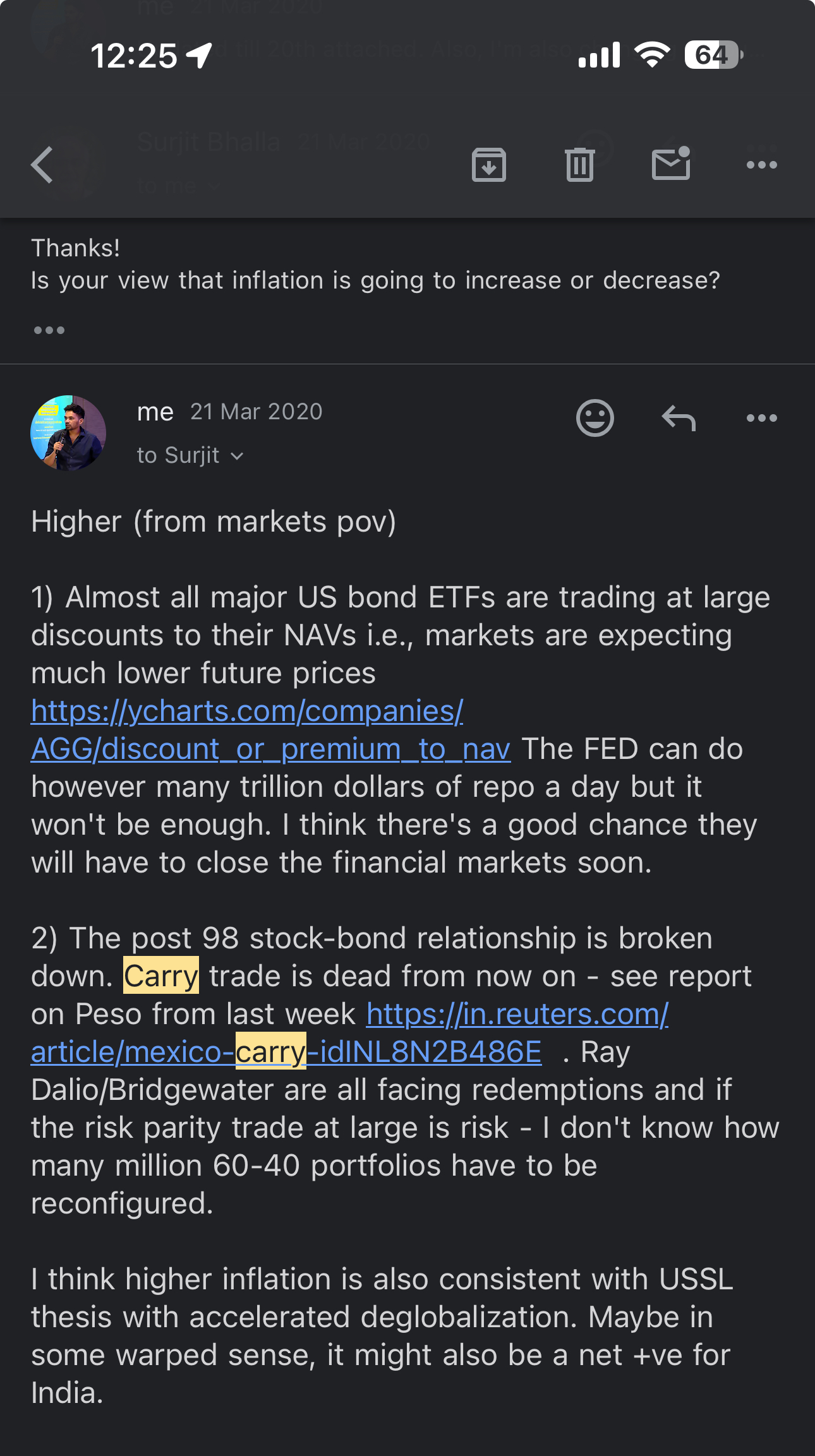
However, what precipitated all of this is actually the COVID-19 pandemic. When something is about to break in international macro/finance, the place to look is Japan and the Yen, which, due to its low inflation environment, has been a constant stream of revenue for carry traders. Something fundamental to the old order broke during the pandemic: Japanese yields, which had been at the zero lower bound (and even hovered in negative territory for periods during the ultra-loose monetary policy era of Quantitative Easing post-2008), bottomed in 2020 and have since been unrelenting despite occasional drops in the monthly headline inflation rate.
The bond market genie was opened in the 1970s for most developed economies in the name of market-based reforms, and several other countries followed suit over the next two decades. My mentor used to often quote President Clinton’s political adviser, James Carville, who famously said in the 1990s, “I used to think that if there was reincarnation, I wanted to come back as the president or the pope or as a .400 baseball hitter. But now I would like to come back as the bond market. You can intimidate everybody.” The message from Carville’s quote is that by the early 1990s, it was not the opposition party or opposition within own party that determined a President’s fate - it was the bond market. This is why Trump, who loved to brag about the stock market in his first stint, turned his attention to the benchmark 10-year yield immediately upon assuming office in his second term. To his credit, Trump had indeed warned about rising prices and inflation rampaging in 2022 at a time when the Federal Reserve was still pondering whether the inflation was “transitory.” Among the critiques of the Fed and central banks around the world, one of the most accurate and devastating is that they are too slow to respond—reacting only after the damage is done, causing even more damage. This is not to take sides with or against Trump, but merely to point out that the mistake was rather obvious from a common-sense perspective. In the midst of the pandemic, I wrote a note to my mentor on the potential structural change that was happening. While I might have been a bit early and overly pessimistic about the Fed being unable to save the system (and financial markets closing - they did close briefly for two days in the Philippines, to be fair), I think I was fairly accurate in my assessment of inflation dynamics, with the benefit of hindsight.
Does the Empire fall?
Is this it? Can we finally declare this time its different?
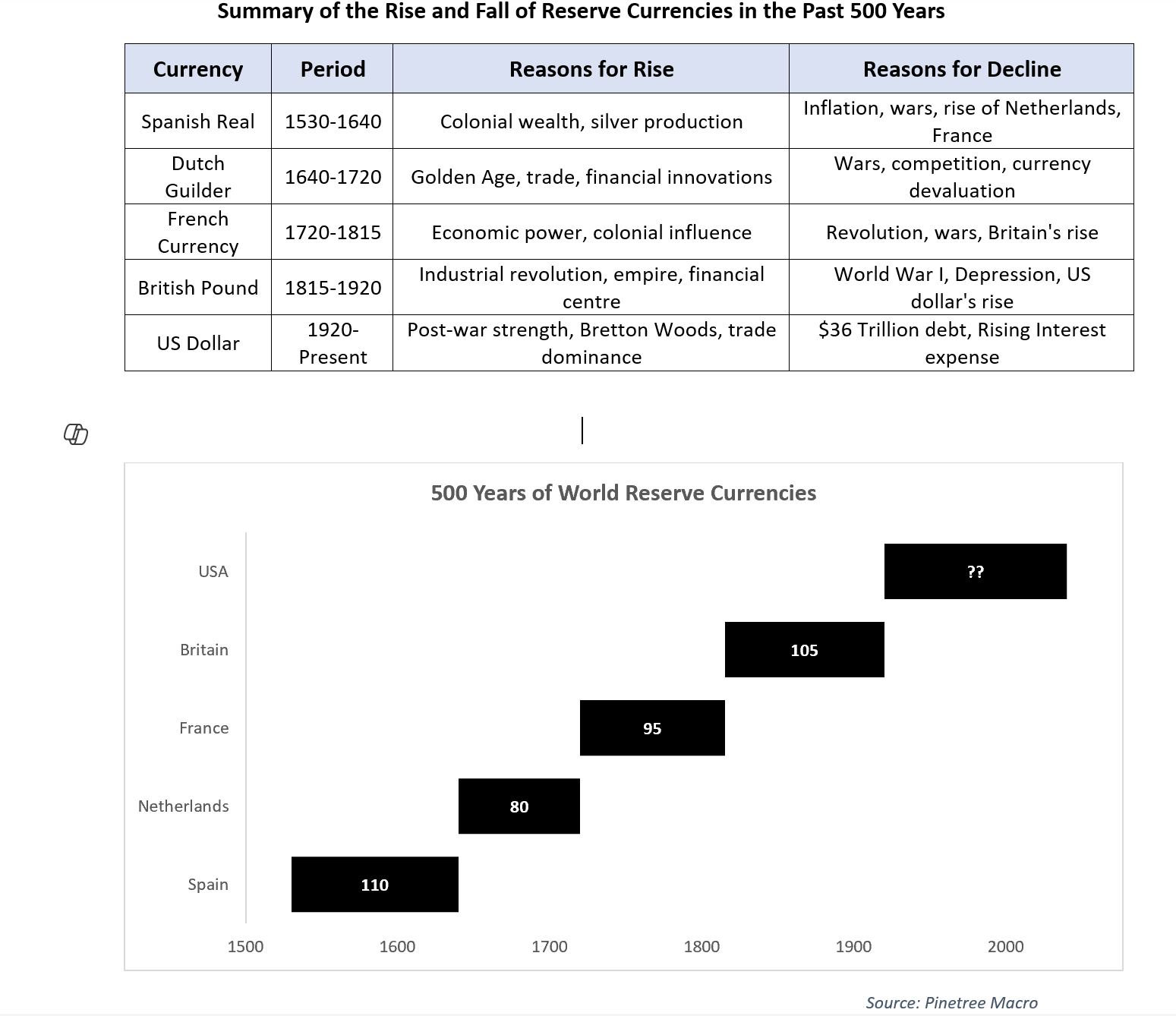
Trump’s election has once again brought into question the lifespan of the dollar as the world’s reserve currency. The dollar index (DXY) fell from its January high of 110.17 on the eve of Trump’s inauguration to almost 103 levels in March which has once again brought life back to the perma-dollar bears and gold bugs. Ritesh Jain of Pinetree Macro Investments has a useful chart and summary on the timeline of the world’s reserve currencies.
However, due to the alchemy of finance, there is at least one more leg remaining before the “new” truly comes to the forefront. For now, we do have something “new,” but it is the old wine in a new bottle variant. Let me take the liberty of speculating a little about how all of this is likely to play out.
While Trump’s tariffs drive the headlines and are sure to rock the global financial markets when the reciprocal tariffs come into effect on April 2nd, it is his domestic policy agenda that might potentially have a greater impact. The US’s trade-to-GDP ratio is only 27% compared to a global average of around 63%, reflecting its deep domestic markets. The coalition Trump has assembled in his second term is much broader than the original MAGA base from his first term. On the economics front, there are two broad camps: the 80s supply-side Reaganites represented by Scott Bessent and the tech-billionaires spearheaded by Elon Musk, who are both gunning to upend the old order. It is instructive to remember Musk’s tweet during the nomination process endorsing Lutnick for Secretary of the Treasury, saying, “…my view, fwiw, is that Bessent is a business-as-usual choice, whereas @howardlutnick will actually enact change… Business-as-usual is driving America bankrupt, so we need change one way or another.” However, one sentiment commonly shared between both camps is the desire to cut down the regulatory state and favor a smaller government. Trump, for now, has played it safe by siding with the former camp and appointing Bessent as Treasury Secretary. In Bessent’s own words, the first of the three critical pillars of President Trump’s America First agenda is “de-leveraging the public sector and re-leveraging the private sector.”
Here, Javier Millei’s Argentina is a useful model to look at. Since his coming to power in December 2023, prices have steadily come down. This process can best be described as detoxification (other words such as “Deep Chainsaw” have also been used). Argentina’s economy has been in severe recession and has contracted every quarter under Millei’s regime. Throughout this detoxification process, Millei has also enjoyed popular support contrary to normal expectations. Something similar is happening in the USA, where Trump’s job approval rating (47%) and personal favorable rating (46%), along with the 44% who believe the country is on the right track, are at all - time highs as per a March poll. There are several reasons to believe in the comparisons between Trump and Millei - Millei, like Trump, is an outsider not representing any of the two major political parties in Argentina.
Kinder World
The alternative view to Triffin’s dilemma was proposed by Charles Kinderberger (1965), who countered Triffin’s perspective by arguing that the balance of payments deficit was not a symptom of a flawed system but a feature stemming from the US banking system’s position as a “world banker.” Kinderberger argued that the US borrowed short-term to lend long-term internationally, which created the appearance of a deficit. While Miran’s Triffin World reflects the US’s fears and pains, Kinderberger’s model is a more accurate reflection of the system of today’s economic world. However, this role as “world banker” has faced headwinds in recent times due to: 1) the relative size of US deficits; and 2) governments across the world being spooked by the sanctions on Russia and Russian oligarchs. The latter is especially pertinent, as foreign governments do not trust the US government enough to store excess trade balances in US Treasuries (UST) anymore.
Adding fuel to the fire, foreign governments are not the only ones spooked by US government sanctions. In the lead-up to the 2024 election, many tech and crypto entrepreneurs — such as Marc Andreessen, David Marcus — came forward, speaking about debanking under President Biden’s administration, which was described as a [#MeToo-type moment in banking](https://x.com/caitlinlong_/status/1862928033025601933?s=12 2).
This concern was raised by Pompeo in his interview at the Conclave, when he used the example of the Indian government: “Our government is way too big for the size of our economy with $36 trillion in debt…I worry that someday the Indians won’t buy our treasury bills.” Stefan Miran goes a step further and suggests that the US, burned by China’s promises during the Phase 1 agreements in 2019, ought to demand some security by “putting China’s Treasury portfolio in escrow.” Despite Pompeo and Miran’s worries, we’re already past this stage, according to Brad Setser, who, referencing Michael Pettis, points out that while foreign reserve accumulation drove financial inflows into the US from 2002 to 2014, the story post-2014 is quite different. Ruchir Sharma, in a recent Financial Times opinion piece, makes a similar claim: it is private capital, led by hedge funds across the world, which has driven US stocks higher—evidenced by the S&P 500 still trading 25 percent above its 150-year trend despite recent declines. Sharma goes further to suggest that this might be the end of American Exceptionalism.
While Sharma might be right in the long run, here’s a thesis of how this might play out in the coming years, and the part where we enter into a bit of fun speculation. While Miran’s paper was written as a policy toolkit, it is useful to recast the four-month experience since the paper was written in November 2024, as well as what is not included in the paper. On the earlier point, the US 10-year yields have cooled off from the January highs of 4.8% to a low of 4.09%, with room to go further south. A major part of this drop can be reasonably attributed to Trump and Treasury Secretary Bessent’s focus on deleveraging the public sector. In addition, the Department of Government Efficiency (DOGE), headed by Elon Musk, has set an ambitious target of reducing the budget deficit by 1 trillion USD and has already reached about 130 billion as of this writing. It does not take a genius to see the direction of capital in a world where the US starts getting its fiscal house in order, while the rest of the world’s governments are saddled by high deficits.
On the latter point of what is not included in Miran's paper, it only makes a passing mention of crypto/bitcoin at the very end where he says "These policies may supercharge efforts of those looking to minimize exposure to the United States. Efforts to find alternatives to the dollar and dollar assets will intensify. There remain significant structural challenges with internationalizing the renminbi or inventing any sort of “BRICS currency,” so any such efforts will likely continue to fail, but alternative reserve assets like gold or cryptocurrencies will likely benefit." It is noteworthy to see only one keyword mention of either crypto/bitcoin in the paper at the same time President Trump going all in on Bitcoin crowd by appointing David Sacks, a well known crypto insider, as a AI and Crypto Czar as well as announcing a "Strategic Crypto Reserve". How does one square this circle?
The USA once made the transition from a dollar-gold convertibility through what is now known as Nixon shock which ended the Bretton Woods system to fiat currency system in 1971-73 that the world now operates under successfully and it would not be wise to bet against another transition to digital currencies, American exceptionalism or otherwise. As I mentioned in my first post, Trump's chances of winning were almost perfectly correlated with the exponential rise in the prices of Bitcoin, other cryptocurrencies and to a less extent gold/silver. Trump has also included various stablecoins in the cryptoreserve as well as launching his own stablecoin called USD1 through World Liberty Financial, the cryptocurrency company started by Donald J. Trump and his sons. Following this on March 13, the Senate Banking Committee passed the GENIUS Act (Guiding and Establishing National Innovation for U.S. Stablecoins) by a vote of 18–6. Sponsored by Senator Bill Hagerty and backed by President Trump, the bill sets clear rules for dollar-backed stablecoins.
What exactly are stablecoins you might ask? Stablecoins, which first emerged in 2014, are designed to maintain a constant value of $1 which makes them useful in order to protect against Bitcoin's inherent price volatility which makes it suicidal to include them in any investment portfolio. The stablecoin marketcap is currently around 145 billion and is roughly a duopoly with the Tether (USDT) and USD Coin (USDC) combined having about 86 percent of market share. How does these stablecoins maintain the 1:1 peg with dollar? Both USDT and USDC claim to be backed by reserves however these claims have not been established by external auditors. Tether states that USDT is backed by a combination of cash, cash equivalents, and other assets. USDC which has a slightly better reputation in comparison is managed by Circle and Coinbase, and it reports that each USDC is backed by a combination of cash and short-duration U.S. government obligations.
You might ask why do I call this "old wine in new bottle"? A couple of years back, I did a postmortem report on another famous algorithmic stablecoin called TerraUSD (UST) which no longer exists. The unique selling point of Terra's blockchain ecosystem unlike USDT and USDC, which are backed by "reserves", was its algorithmic stablecoin TerraUSD (UST). LUNA was the native cryptocurrency of the Terra blockchain which played a crucial role in the Terra blockchain ecosystem by relying on a mint and burn mechanism in order to maintain the 1:1 dollar peg. UST was launched in 2020 conjunction with Anchor, a lending protocol native to the Terra blockchain where users could earn 20% to 50% interest on UST deposits. This triggered a massive demand and drove UST’s exponential growth from 180 mil USD in January 2021 to nearly 10 bil USD in January 2022 and basically allowed anyone to earn easy money with Anchor. However in May 2022, Terra experienced a catastrophic collapse which triggered a massive rethink among the crypto community on the viability of algorithmic stablecoins and have come to the conclusion that these can result in devastating death spirals. In short, a version of Mundell-Fleming Trilemma of international economics also applies to stablecoins by choosing between: 1) Peg security 2) Capital efficiency 3) Decentralization. I refer readers to this blog post for further details on this topic but what this has resulted in is that the stablecoin market is has come to be dominated by USDT and USDC whose reserves similar to the infamous gold-reserves in Fort Knox, which Trump and Musk now want to audit, or in the London Banks in the early 30s are up in the air.
Here is where Trump's Bitcoin and DOGE gambit fit into what one might call a "system transition". From it's origins, understanding the nature of cryptocurrencies has been a difficult task. The SEC sees cryptocurrencies as securities, necessitating regulatory compliance, while the CFTC classifies them as commodities, focusing on market fairness. As is obvious from the name, they are also treated as currencies by some. However, what has been increasingly clear about a key function they perform is as a hedge against potential risks against debanking and in some cases sovereign default risks. On the latter, Ahmed et al. (2024) examine how sovereign default risk influences cryptocurrency adoption across G20 countries, finding that a rise in sovereign credit default swap (CDS) spreads correlates with increased cryptocurrency app downloads. A 10% increase in sovereign CDS spreads is associated with a 2.9-4% increase in crypto app downloads and usage, and crypto adoption jumps in the months following news related to sovereign risk. This effect is particularly strong in emerging markets and in periods of heightened financial instability.
One of the most striking aspects of this entire issue is how it highlights the shifting dynamics of power and finance. Governments have traditionally controlled monetary systems, but with rising economic instability, individuals are increasingly turning to alternative financial instruments. Cryptocurrencies, in particular, have emerged as both a hedge against risk and a tool for capital flight, challenging traditional regulatory frameworks. The data clearly shows that when sovereign default risks rise, so does crypto adoption. This isn’t just a coincidence - it’s a response to uncertainty, a symptom of distrust in traditional financial institutions.
The same pattern holds for capital flight: in economies with restrictive capital controls, crypto serves as an escape route. A 2024 IMF working paper titled "Crypto as a Marketplace for Capital Flight" explores how cryptocurrencies facilitate capital flight in economies facing financial instability and restrictive capital controls. It finds that crypto premiums - which are essentially price differentials across fiat currencies - serve as an indicator of capital outflows. Since the original publication in June 2024, the authors periodically update the data on crypto premiums for about 42 currencies around the world. Based on the latest data, the graph below visualizes these premiums across various currencies, with Argentina and Nigeria showing the highest premiums, indicating significant capital flight. The lower charts illustrate historical trends of crypto premiums for select currencies, highlighting surges during economic crises or geopolitical instability. The study underscores how crypto markets act as alternative avenues for moving capital in restrictive financial environments.
How can we explain this behavior? Contrary to Pompeo's fears on governments across the world "dumping" existing treasury holdings or not buying new ones, the problem is the citizens of these countries don't trust their own governments enough to store their savings in local currency bank accounts because of their own issues with money printing, inflation as well as a host of other issues. A cursory look at Latin America, is a precursor of how this might play out in the near future i.e., these citizens would rather store their wealth in US dollars backed stablecoins which will be invested in USTs. Foreign citizens replacing their governments as marginal buyers of USTs is a reasonable plan provided US starts getting its fiscal house in order.
How can governments across respond to this upcoming change? History suggests that financial control is a constant tug-of-war. And right now, most governments in power are dealt with a pretty bad hand to play. In the same conclave in which Pompeo spoke, the Chief Minister of the state of Telangana when asked about the promises of freebies made to voters during the campaign, lamented about the fact that he only came to be aware of the state's bleak finances after coming to power.
As crises unfold, the movement of capital - whether legal or not - will follow the path of least resistance. On the economic front, that path increasingly leads from fiat to digital currencies in the form of cryptocurrencies. It is clear that there will be financial instability, crisis and pain as this unfolds over the coming months and years as indicated in Miran's paper. Whether one is trying to find a method in this madness or a confluence of events, it does seem that all of this is part of Trump 2.0's calculation.